
Developed by a team of IRD scientists eager to share their knowledge, The MARECO educational kit aims to inform and raise awareness among young people about the challenges of protecting the coral reef, and to provide them with essential knowledge to understand this unique ecosystem. For this purpose, the briefcase contains four resources to discover reef biodiversity, threats and solutions to manage the coral reef in a concerted manner.
The briefcase is designed for children aged 4 to 12 (primary and secondary), in two languages: French and English. It is accompanied by an educator’s booklet whose first part gives a range of scientific knowledge to possess (in the form of sheets) and the second part proposes educational exploitation for each of the 4 tools.
Educational booklet to download here.
The case is also used as a multidisciplinary research tool to assess the social representation of coral reefs among local communities in the southwest Indian Ocean, metropolitan France and Pacific islands.
The educational materials of the MARECO case are royalty-free for non-commercial use and can be downloaded from the links below.
the album : Colours of the coral reef
The marine world fascinates children, especially if they discover it in the form of a story with illustrations. In this album, Polly, a nice little character who appears as a coral polyp, takes us to discover her habitat, the coral reef. Throughout the pages are presented different aspects of this ecosystem, which appears to be in more or less good health: its richness, its fragility, the natural and human disturbances it undergoes, and its management through the establishment of a marine protected area. In each illustration, there are grayed-out patterns, detoured, which refer to the color patterns of the cutting board. The last illustration presents a global view of a healthy reef, with different kinds of fish to be identified. A coloring board is also attached to the album.
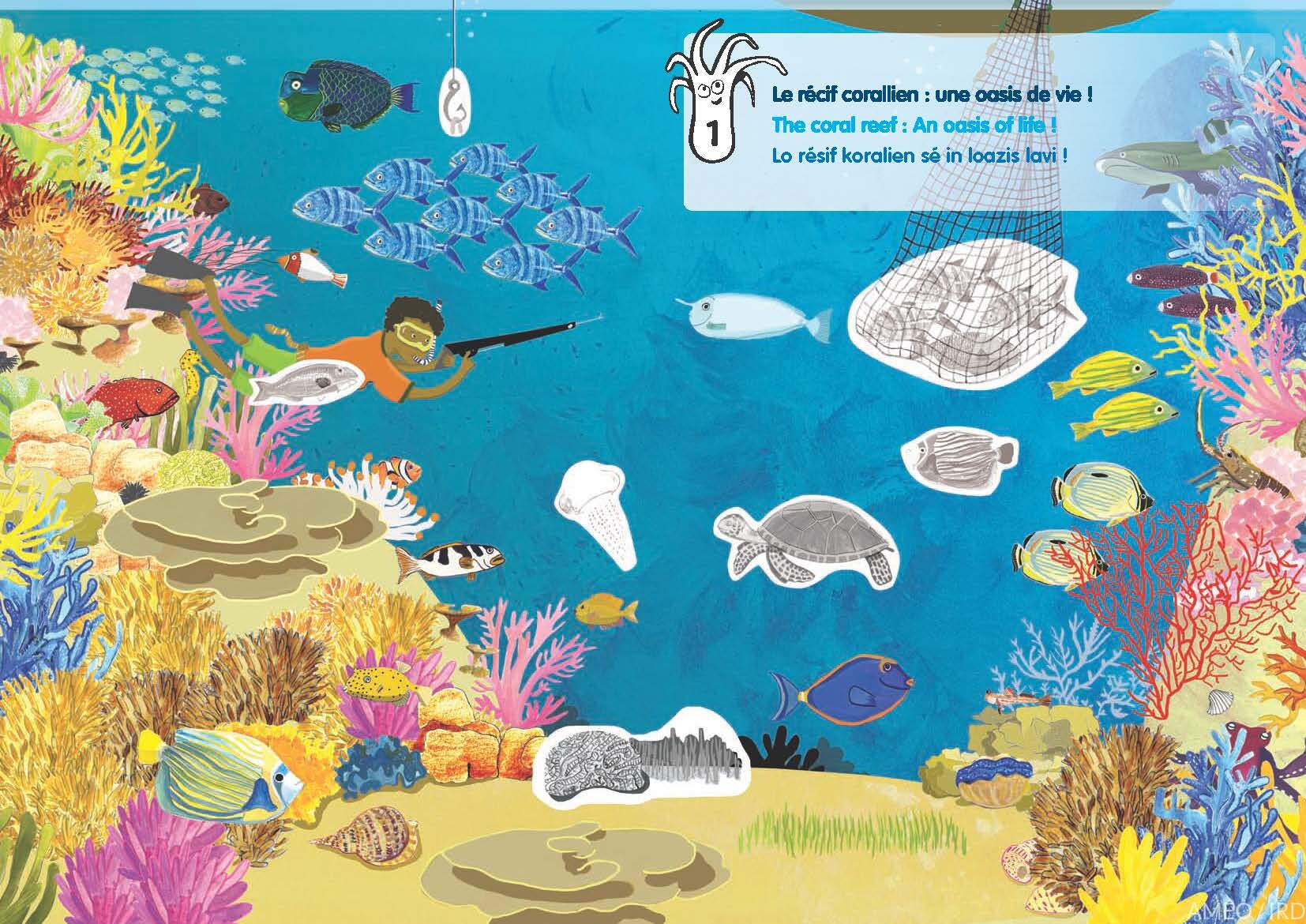
Goal of the game: Position the stickers and follow the story of Polly, the polyp that presents its environment, the coral reef, and explains why it is deteriorating.
Age: 6-12 years old
Languages: Available in French, English, Swahili, and Creole Réunionnais.
Keywords: coral reef, state of health, degradation, plastic waste, solutions, biodiversity, climate change, turtle, fishing, anchor, pollution, shark.
Downloadable materials: the stickers and the album in 3 versions:
The Poster « the garden under the sea »
This poster is from the album “les couleurs du récif”. It helps to understand the marine biodiversity of coral reefs and can also be used to learn to recognize marine organisms and name them in a fun way.
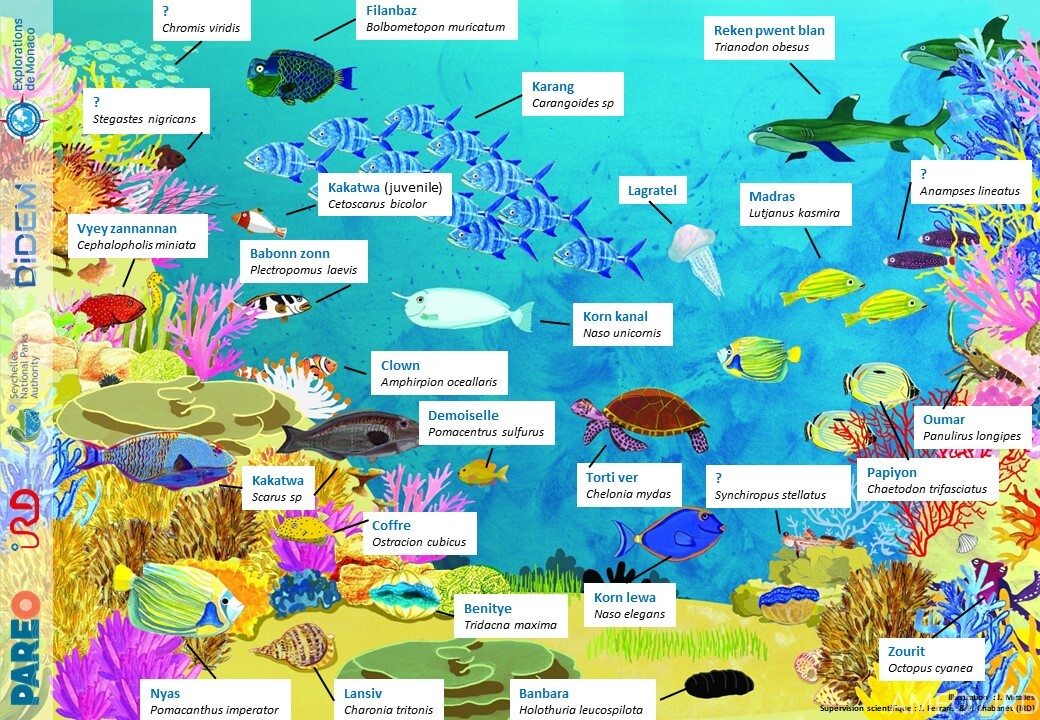
Goal of the game: Find the names of the inhabitants of the reef that appear on the poster. Which ones are edible? Have you spotted the seahorse, octopus, and lobster? Compare their names in the different languages used in the Indian Ocean. What is the scientific name?
Age: 4-12 years old
Support and languages: blank poster or with labels in French, English, Creolereunionnais, Seychellois Creole, Comorian languages and scientific names.
Keywords: coral reef, identification, fish, scientific name, Indian Ocean
Downloadable materials:
- Blank poster vierge to complete
- Posters with french names
- Poster with english names
- Poster with créole réunionnais names
- Poster with créole mauricien names
- Poster with créole seychellois names
- Poster with grand comorien names
- Poster with mohélien names.
the 7 families of the reef
In the card game of the 7 families of the reef, the living animals and plants that inhabit the coral reef are presented to children in a playful way. It is not, in fact, photographs, but illustrations of a comic strip type where these living beings are most often personified. They are therefore easily adopted by children, who thus more easily appropriate the concepts to work: biodiversity and classification, interactions between species (predation, associations). The meaning given here to the word family is not the one used for classification, but takes up the name of the classic game of 7 families by grouping various species into fictitious groups. Each family comprises 6 members, each corresponding to a division of the living world. The members that make up it have common characteristics represented by a symbol. Each of these divisions is itself represented by a species that characterizes it. We find at the bottom of the card his French common name and his Latin name. On each map, there is also a small text that characterizes the species, which allows the game to be conceived as a little book of stories about the inhabitants of the reef. The game is designed for 2 to 6 players. The rule of the game is identical to that of a classic family game: the goal is to reconstitute as many complete families as possible.
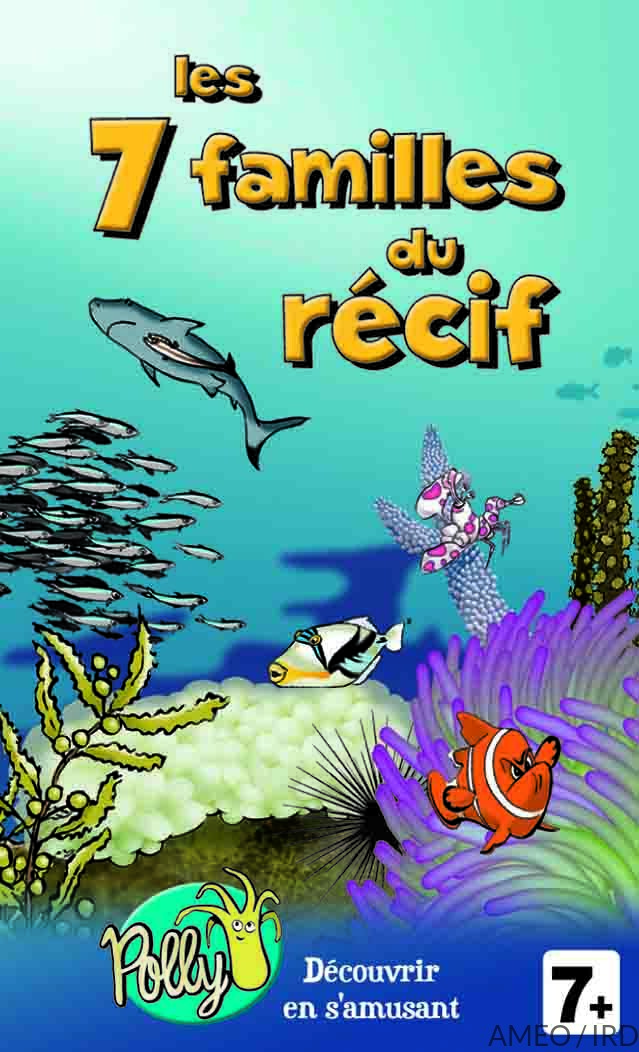
Goal of the game: Play the game of 7 families to discover with the families Patouche or Collé serré who live on the coral reef. In this game, the family members are vertebrates, mollusks and echinoderms to approach the notion of scientific classification in a fun way. Also discover on each card an anecdote to learn more about each animal.
Age: 5-12 years old
Languages: Available in French, English, swahili
Keywords: coral reef, biodiversity, animals, algae, classification, turtle, whale, coral
Downloadable materials:
The role-playing game: meeting at the reef
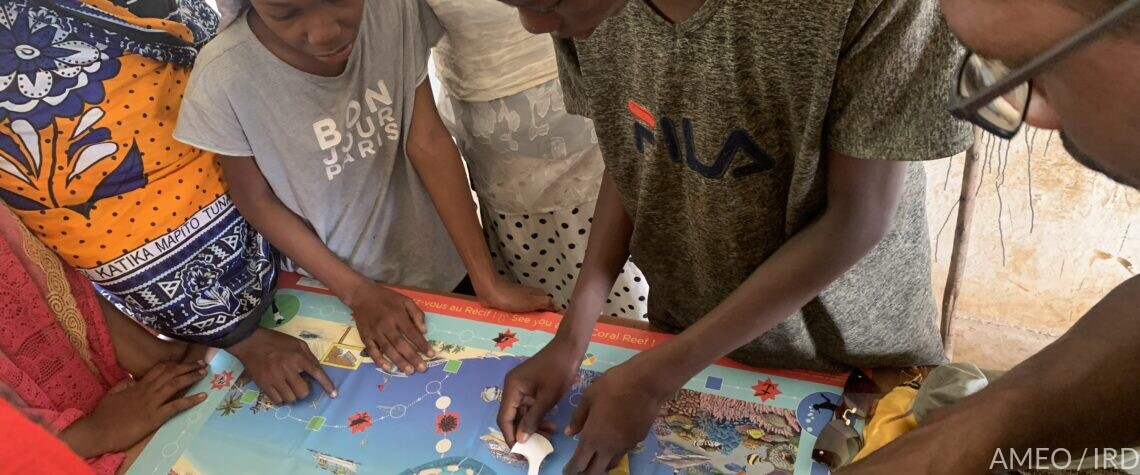
The game Rendez-vous au récif is a cooperative board game that features different users of the coral reef. The objective is to make children aware that, in order to be effective, coral reef management must take into account the different users and above all promote cooperation between them. Four main types of users, with different behaviors were selected: fishermen, tourists, coastal residents and protected marine area agents. The game looks like a game of goose, with several possible paths. The central coral island, in the form of a removable puzzle, constitutes its arrival. The course is dotted with “winning boxes” (collect tokens, after 4 you can reach the island) or “losing boxes” (pictograms with different types of attacks on the reef, then remove a piece from the island). Each of the 4 players takes on the role of a user. The goal is to reach the reef before it is destroyed: we must therefore do everything possible to preserve the coral reef and its resources. But to win, all users (and not just one!) must meet together on the island, and therefore help each other. Fewer users are more likely to win, and as the number of players increases, so does the risk of destroying the reef, which reflects the pressure on coral reefs from a growing number of users. There is no “rebuild” box for the reef because we can only destroy or preserve the coral reefs.
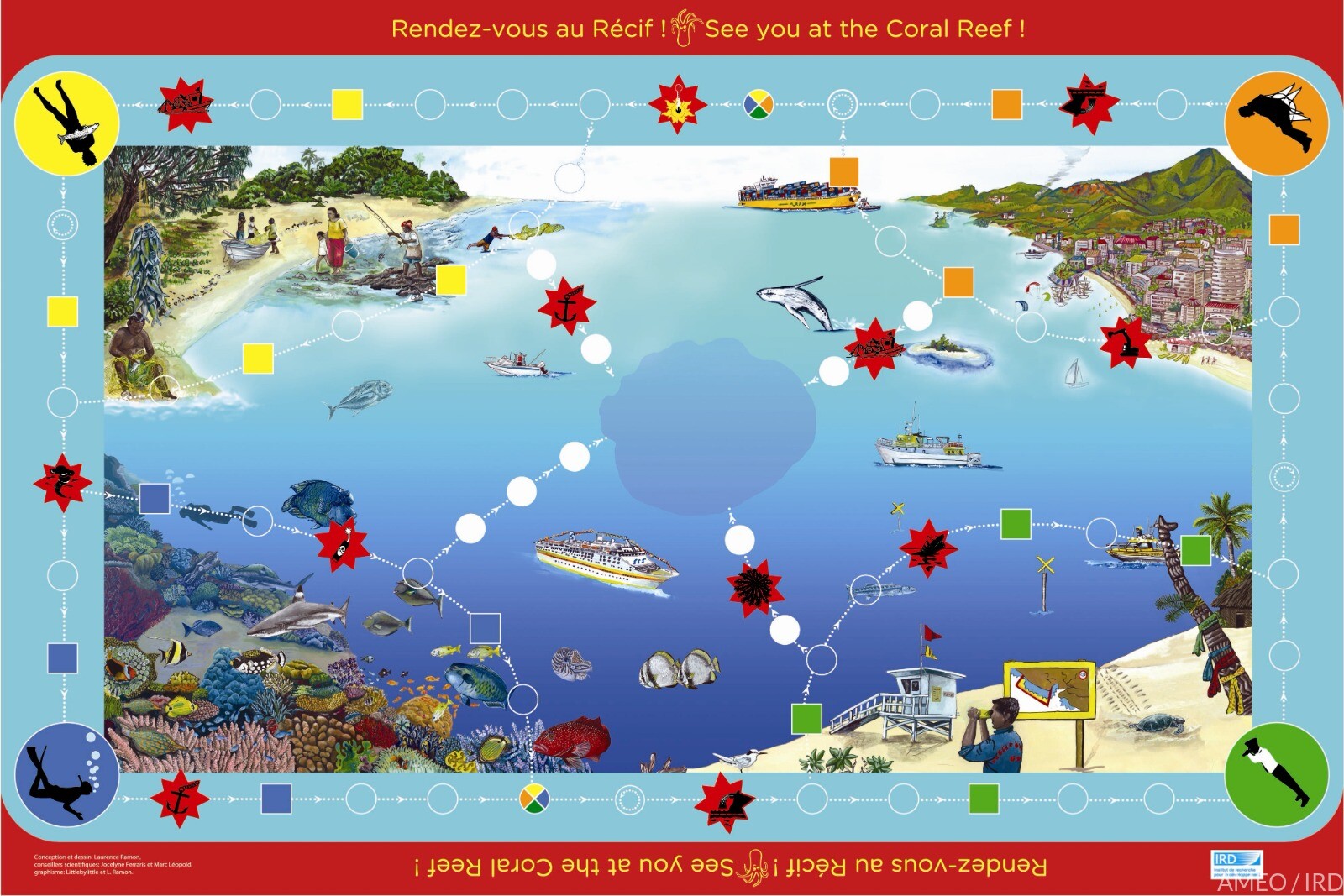
Goal of the game: In the shoes of a fisherman, a tourist, an eco-guard or the mayor of the city, players try together to understand what destroyed the coral reef and propose sustainable solutions to give it time to rebuild. Once the reef is rebuilt, the first person to arrive on the island will become the president! But be careful, he must commit to respecting the solutions put in place and protect the reef for a long time!
Age: aged 6+
Languages : Available in French and English
Keywords: coral reef, management, sustainable, fishing, tourism, guard, scientific, decision-maker, policy, city, coral, barrier, marine park, marine reserve.
Downloadable materials: